


Bucher probably met Tschirnhaus in Silesia in 1702 (to see what Bucher was up to see the post that leads to this post as noted in the sources below). Tschirnhaus had just left his days of working with Leibnitz in Paris to concentrate on figuring out how to make porcelain – a topic that obsessed people around 1700 almost as much as the possible immortality of animal souls and the many minor annoyances of not-very-helpful demons. As we will see, the Arch-early-enlightener Thomasius could be harsh on the skepticism of people like Bucher and Tschirnhaus in these matters. Bucher wasn’t exactly skeptical about anything, but – like Gabriel Wagner and Tschirnhaus – he thought Thomasius’ free-thinking on “spirits” was producing too many possible ghosts and things. Ghostly or similar spiritualistic excesses were a topic where the most radical Enlighteners could agree with even the grumpiest of the Orthodox that an excess of free-floating spiritual substances was not a good idea, even if it was a pet project of Thomasius at Halle.
Things could get confusing. Bucher’s secretive efforts to reduce the range of confusing spiritual substances by clarifying what Aristotle actually said about souls (and downplaying some scholastic elaborations involving transitional modes of spiritual substances) and referring interested readers of his soon-to-be pirated letters which would soon be spirited out of a Halle professor’s papers as far as Mulsow can tell (see the sources below) – anyway – referring interested readers to Westphal’s Pathologia Daemoniaca of 1707 for a look at how the interlocking layers of the body and soul and mind could operate theosophically with very subtle material substances if necessary. And they might well need to since Melanchthon, in fine-tuning Lutheran Orthodox Metaphysics in the mid-sixteenth century, seems to have excluded the rational faculties of the mind from the metaphysical substances of the soul – which – oddly enough – might have helped Lutherans tolerate rationality as a natural human activity rather than yet another corrupted form of potential cosmic evil infested with inherently doomed foulness by the Fall which would be the case if a soul were left to its own non-mental devices. A careful Lutheran in 1700 might have to look elsewhere than in his own potentially doomed soul for demons and for rationality. Curiously, with all that, his rational mind was his own more or less, for what it was worth and Melanchthon thought rational observation of the natural world was relatively harmless – even instructive.
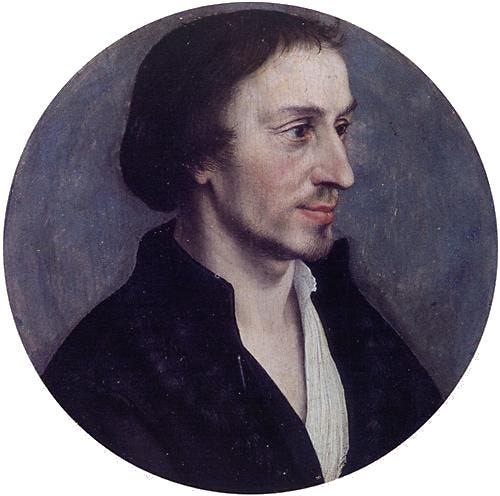
Melanchthon by Holbein
Yet thinking about such things could get you into a lot of trouble, as Johann Hocheisen found when he set out to refute Westphal’s weird scheme of immaterial spiritual substances in one of those graduate disputations at Wittenberg. Hocheisen set out to refute what he claimed was the secret deist agenda in Pathologia Daemoniaca. No one at Wittenberg thought Hocheisen was seriously anti-theosophical and nobody really knew what deism was in Wittenberg in 1709, and so Hocheisen went off to teach High School in Silesia, where he pursued his lonely quest to refute and exorcise deism in all its forms from our demonic-substance-haunted world.
Mulsow notes that all of this seems to indicate that at least two different forms of secularization were happening in the Lutheran early Enlightenment. You could have the Wittenberg form where adjustments in the imagery of the soul could be put forward as better methods for defending Orthodoxy, which, where the soul was concerned, was quite confusing.
And you could have the Halle form where medical concerns could be separated as a special mode of Christian ethics from a totally Orthodox (if Pietist) overall theological world view. Bucher’s case brings out some of the stylistic dynamics of the situation since his vaguely heretical letters about the soul were dreamed up in Wittenberg, found in the papers of a professor at Halle, published in Jena and eventually exposed as the work of Bucher by Thomasius at Halle. Thomasius’ interest in exposing Bucher may well have been based on the exuberant mockery of his theosophically-based subtle soul substances in the extremely anonymous preface introduced in the pirated Jena edition of Bucher’s letters. This semi-satirical preface of 1713 suggested that people like Thomasius, who had no actual Enlightened ideas to contribute in the current situation, would be inventing spiritual substances that sounded vaguely heretical just to make themselves seem Enlightened when in fact, they were just antiquated posers. Not the sort of thing that the astoundingly legal architect of the complete post-Pufendorf structure of natural law wanted to hear.
But that was in 1717. By then, Bucher had used his connections with the medical/chemical faculty at Halle to produce his final medical dissertation in 1707 using some of the more advanced Cartesian formulations for physiological events found in the works of Frederick Hoffman at Halle and Ehrenfried Walther von Tschirnhaus who was still busy re-inventing porcelain for his patrons in the Electoral court in Dresden. Indeed, Bucher dedicated his dissertation to Tschirnhaus.
By 1707, things were moving fast on the Halle circuit of the Enlightenment. Tschirnhaus, Leibnitz and Thomasius had all recommended Christian Wolff as their all-around naturalist and mathematician and by 1709 he was lecturing there on experimental physics. This all might suggest there was another mode of secularization – the Leibnitzian mode where theology runs on an abundance of Molinist grace pulsating with pre-established harmony deep into the interior of every possible history of every possible particle in every possible universe so that physics and theology are the same discipline and this was seen as excluding Newtonian views at many levels.
But even as Bucher went off to work for the Saxon court, Wolff and Tschirnhaus had already begun to suggest very tentatively that the Leibnitzian cosmic scheme was neither entirely convincing overall nor workable in detail. In the next post, this gets us to Wolff in about 1720 as he discovers strange problems in the Leibnitzian schemes, begins to follow some of Tschirnhaus’s alternative approaches to logic and science, starts to get into serious trouble with the Pietists in Halle and sets off on the wild journey to the invention of Aesthetics.
Sources:
MOGENS LÆRKE
“A Circle Without a Circle: Ehrenfried Walther von Tschirnhaus’s Natural Scientific Method” Journal of Modern Philosophy, 2026
https://en.wikipedia.org/wiki/Philip_Melanchthon
https://en.wikipedia.org/wiki/Molinism
Juan Garcia’s article:
Stefanie Buchenau. The Founding of Aesthetics in the German Enlightenment:
The Art of Invention and the Invention of Art. Cambridge-New York: Cambridge University Press, 2013.
Mulsow, Martin, trans H. C. Erik Midelfort (!yes!) The Hidden Origins of the German Enlightenment, Cambridge U, 2023
Beyond Dordt and De Auxiliis The Dynamics of Protestant and Catholic Soteriology in the Sixteenth and Seventeenth Centuries Edited by Jordan J. Ballor, Matthew T. Gaetano, and David S. Sytsma, Brill, 2019
Clark, Christopher Iron Kingdom, Harvard U, 2006
And the post that came just before this one:
And topics: