


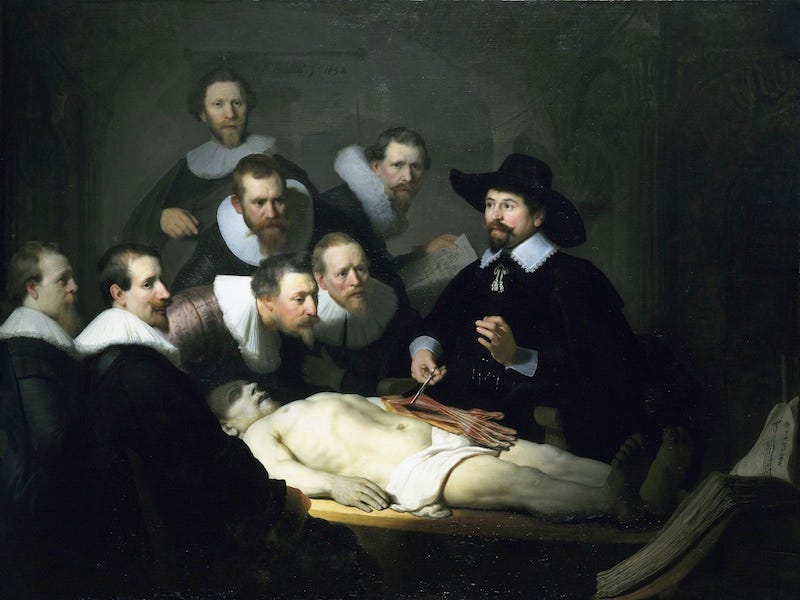
From a strictly aesthetic point of view, the Enlightenment begins with the broad consideration, in many spheres across the Western World, of the possibility that the human side of Humanity and the natural side of Nature, might, in reflecting each other, have unusual and otherwise unthinkable constructive possibilities. This might, even at the time when Western Civ had not really yet constructed its strange Historicist self-alienating image of itself, have come along with the idea that such considerations are idolatrous or even evil in themselves.
Not a particularly healthy mix, but Aesthetics is a somewhat unhealthy approach to reality as we will see when the unhealthy Pietists in Halle get rolling in the 1730s.
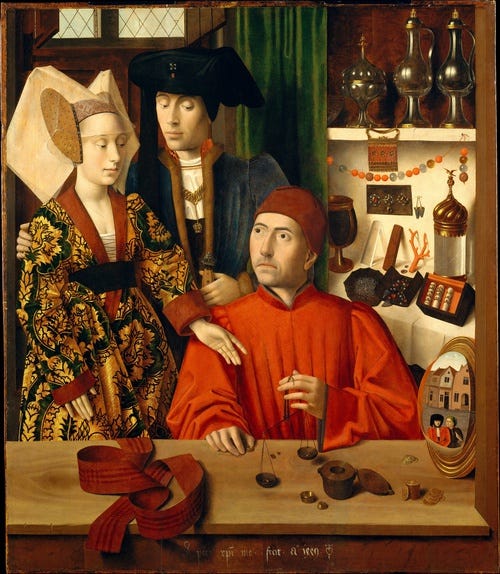
Anyway, the questions of what exactly is human about Humanity and/or natural about Nature are at the core of the dynamics of the Enlightenment and such questions are built into the early generator of the Enlightenment, the Prussian University of Halle, founded in 1694 and where the natural rationality of Wolff confronted the human Humanity of the Pietists. By the 1730s, Alexander Baumgarten at Halle was working to resolve this confrontation in terms of his invention of Aesthetics as a philosophical approach.
The next post will deal more with Nature but for now we will stick to the human side of the Enlightenment project.
The Enlightenment-inducing Endgame of Who’s Human Now, really gets kicked off in Spain in the mid-sixteenth century with the question of how the Imago Dei (ie man as the not entirely human image of God as described in Genesis) functions in such notably otherwise completely human people as the Aztecs of the Aztec Empire. The answer, I suppose much to everyone’s surprise, was that everybody was human. Who knew? Well, theologically of course, that caused a pretty intense bout of Last-Minute Late Scholasticism, because well, if the Aztecs were human and still had an internal functioning Imago Dei – well, who else did we know who might also be human?
That’s right: Jesus.
There are some odd intermediate metaphysical problems with digging out the possibly provisional or even temporary humanity of entities. For example, the Imago Dei is a wreck because of the Fall of Man and (at least as noted by Calvin) Angels also have an Imago Dei and theirs is mostly in better shape than ours so in some ways Angels are more human than people are. Still, the question of how the Imago Dei worked in Jesus turned out to be quite tricky and so by the 1580s when the Auxilium problem starts brewing, Calvin in the 1530s had already worked on this problem and been expelled from Geneva for being an Arian and the Jesuits in Spain were about to find out that as soon as you begin to wonder about who else might be human and how exactly that might work, you have opened a highly heretical can of worms. It’s like poking the Divine AI Core right in the eye and saying “Open Pod Bay doors please, HAL or Jesus or Daisy, Daisy, give me your answer, do.”
And it just gets worse. As we will see in Aesthetic terms, the humanity of Humanity is also a problem for the self-image of Western Civ (after it gives up on the imagery of the Enlightenment) with its need to have an Imago of itself in itself that shows itself how it is even more human and/or Divine than the other people on the planet. It’s quite simple in the end, as Hegel proves: Western Civ is more human or Divine than other people because Western Civ has an Ideal mental Historicist form of History and is really Ancient Greece in an even more Spiritual (Human plus Divine) form cyclically sublimating itself into ever more perfect and complete forms such as Berlin in the 1820s. You don’t need Scholasticism for that or even Guns and Germs, you just need Ancient Greece and Hegel. We will see how that starts falling apart by 1870 eventually, I hope.
Back to the Auxilium. Calvin, of course, recanted his apparent lapse into Arianism and got back to Geneva. Similarly, Cardinal Bellarmine – a decade before he delt with Galileo’s Heliocentric problem – moved toward a more orthodox position in resolving the thing with the Auxilium in 1607, but (as we will see), his more moderate position was almost immediately forgotten given the universal controversialist convenience of opposing the Orthodox position (which included the Dominicans, the Inquisitors, the Reformed Calvinists and the Lutherans) to the less Orthodox position (which included the Jesuits, the Molinists, the Remonstrant Calvinists, the Arminians and the Jansenists). As we will see, Bellarine and Suarez’s moderate intermediate interpretation was too harmless to excite much interest.
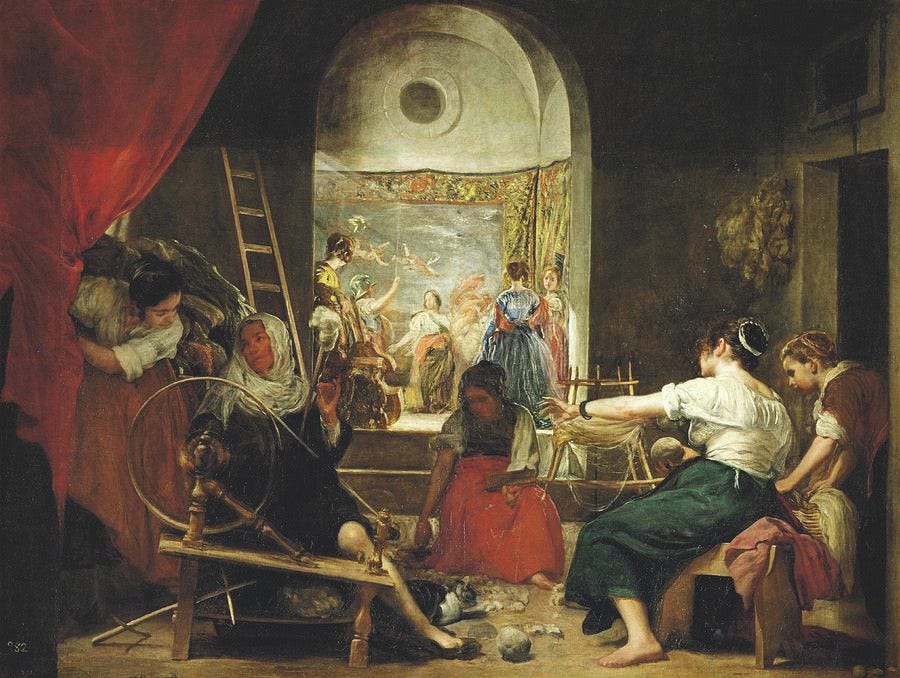
So what is the Auxilium at the center of the Auxilium controversy? In the New Cambridge Companion to St. Thomas Aquinas, it is noted that Aquinas noted that the auxilium is a particularly active form of grace, a gratuitous divine gift that exceeds our human nature with respect to a particular instance of knowing or willing or doing something. So in other words the credible hulk might normally be a nice guy (by habitual grace) but when he does something particularly mental he may be effectively actuated by actual grace in an auxiliary mode. Note that the controversy and its many echoes would be a matter of the answer to the question “Is the credible hulk actuated by active grace or does he use or access active grace – the auxilium?” If it is just there as provided by God – only a whiff away from his day-to-day hulky nature – then all is well from the Orthodox Dominican or Lutheran or even (possibly – this seems to be a misreading of Calvin if you ask me, but I’m pretty much an Arminian on that score) Calvinist point of view. Of course the Calvinist version means the hulk runs the chance of being wrong twice with the divine backup plan of doubly predestining the hulk as a reprobate eventually. But apparently in the early 1580s, the Jesuits – particularly in the Low Countries where they were trying to convert non-Catholics back to Catholicism – asked what if the credible hulk could somehow actively trigger an instance of the auxilium on his own all by himself by nothing more than some mental quirk or mental action or remembering a set of memories in a particular way?
Theologically speaking though, if the credible hulk can mentally act so as to think his way into his own salvation on his own, then theologically there has to be a very good chance he is wrong, very wrong terribly wrong and predestined to undergo double predestination as God foresees his meddling in his own mind before after or during the creation of the world. Yes, God can foresee how the credible hulk could be a complete reprobate and get blasted straight to hell for his own (predestination A he is possibly saved, but B, thinking it over gets predestination B for thinking it over) good. Note that Article 17 of the 39 Articles of Faith as sworn to by Isaac Newton and other Anglicans does not include double predestination and when there was a move to alter Article 17 in 1595, Queen Elizabeth refused to endorse a new version of Article 17 that would include double predestination. Set game and match to Queen Elizabeth, and some additional points to the Queen for helping get the Enlightenment started on its winding way because the last thing an Enlightened fella needs is God’s need to take a second shot at him.
Okay so, what is the theological problem here? Well, the Fall of Man. Because of that, the Imago Dei as described in Genesis, cuts both ways and it can get you into a lot of trouble. In a nutshell, it’s corrupt in every possible way. After the Fall, sure you’re human, but that and a nickel will just get you sent to hell. Yes, buddy, there’s a problem with your soul, your mind, your brain, your Imago Dei, your spirit, your once oh-so-nice universe is corrupt and strictly speaking, not even particularly functional, you can’t even make up your own mind about your salvation without a little help from God – who – suspiciously enough – also has known for thousands of years that he is going to kill you twice if that’s what it takes. You may think you think, but don’t be so sure because your mind, your brain, your soul, your spirit etc. is corrupt etc. in every possible way etc.
But, it isn’t so bad really.
Or is it? The way Calvin sees it, in the most extreme case, the Imago Dei is like a get-away car loaded with very old dynamite that has been overheated a few times and is sweating beads of nitroglycerin. Sure you get away into sin-free salvation. Or so you think. Then bang! Second predestination makes you pay for your illusion of freedom the hard way with a trip straight to hell. You have to admire Calvin’s killer instinct; Calvin’s God doesn’t just not miss – He lets you run happy for a bit then boom! Lets your own badly contrived nature blow you up as was foreseen more or less.
Other theologians (that is – not Calvin, who was quite ready to let God bump you off twice if needed for different reasons) toyed with the idea of just how wrong you could be with your Fallen mind seeming to think about things. Maybe God just doesn’t let the first granting of grace work on you and that’s that. He knows you’re doomed and your heart is hardened like that of the irredeemable Pharaoh for example.
Anyway, don’t think you can just think your way out of that because even if God doesn’t drop you twice like a hot potato, the Inquisition may burn you personally for some other technical violation.
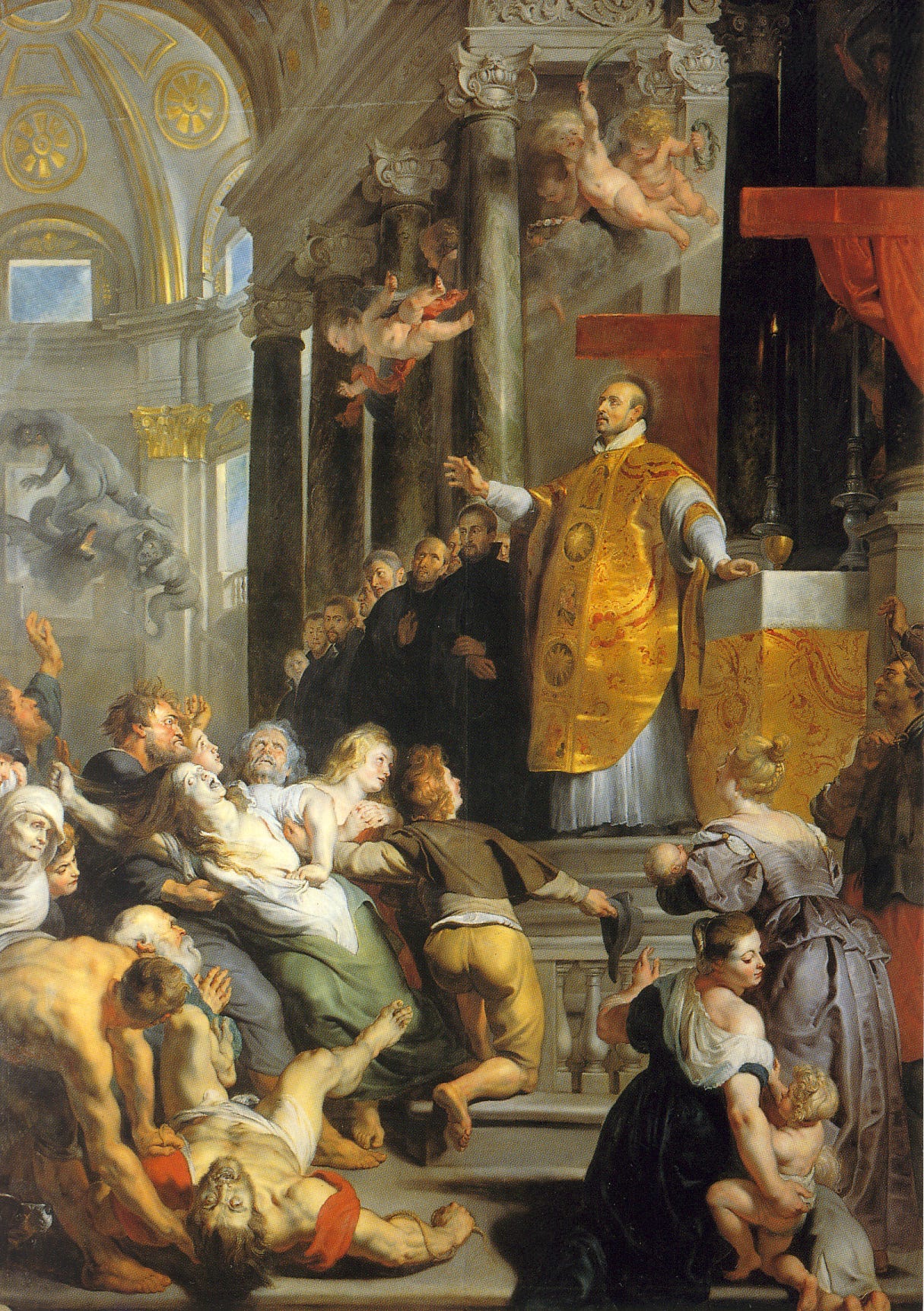
So, eventually, push came to shove beginning in 1582 in Salamanca with a debate over whether Jesus knew what he was doing by thinking things over or by directly Providential Cosmic Dispensation.
For a while, it looked like the Jesuits, who suspected that Jesus probably thought about things and decided what to do more or less on his own, were going to be turned over to the Inquisition for “Questioning” (ouch) since that’s the sort of thing that gets you burned alive pretty fast. But some quick thinking and fancy footwork by Cardinal Bellarmine and some others managed to get a thing going in Rome in 1597: the Congregatio de Auxiliis.
Stay tuned. Next time. Will the Jesuits be tortured and burned alive by the Inquisition? Or what?
Sources:
Beyond Dordt and De Auxiliis The Dynamics of Protestant and Catholic Soteriology in the Sixteenth and Seventeenth Centuries Edited by Jordan J. Ballor, Matthew T. Gaetano, and David S. Sytsma, Brill, 2019
https://en.wikipedia.org/wiki/Thirty-nine_Articles
https://en.wikipedia.org/wiki/Congregatio_de_Auxiliis
https://plato.stanford.edu/cgi-bin/encyclopedia/archinfo.cgi?entry=school-salamanca&archive=spr2021
Mulsow, Martin, trans H. C. Erik Midelfort (!yes!) The Hidden Origins of the German Enlightenment, Cambridge U, 2023
The New Cambridge Companion to Aquinas , pp. 233 - 256
DOI: https://doi.org/10.1017/9781009043595.015[Opens in a new window]
Publisher: Cambridge University Press
Print publication year: 2022
Journal of Jesuit studies 7 (2020) 417-446 brill.com/jjs A Sketch of the Controversy de auxiliis R. J. Matava Notre Dame Graduate School of Christendom College, Alexandria, VA, USA rmatava@christendom.