

Genius in Two Nutshells
Wolff Avoids a lot of the Leibnitzian Cosmos in the Nick of Time

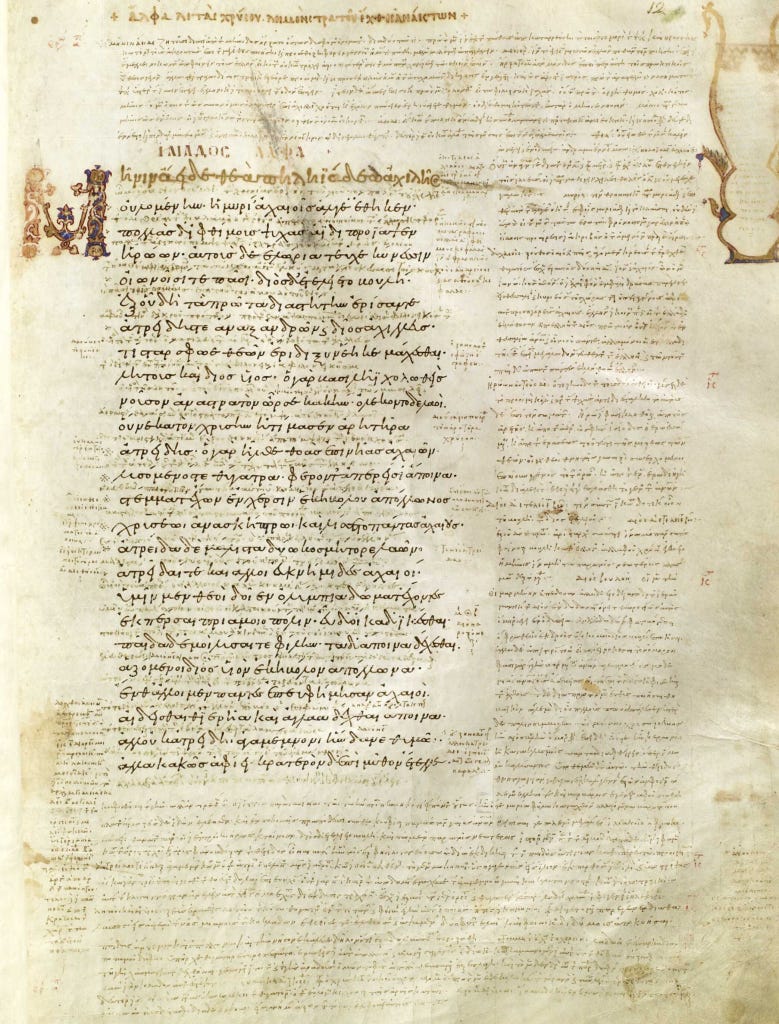
The above is a section of the Iliad surrounded by scholia. The manuscript is Venetus A (Venice, Biblioteca Marciana, gr. 822).
Just to sort of give away a hint of where all of this is going, in Section 47 of the Critique of Judgement, Kant suggests that, by his criteria, Homer is a better example of what genius is than is Newton. Earlier critics on the way to some sort of assessment of the nature of the Aesthetic assessment of Genius suggested Milton as the exemplary Genius. But leave it to Kant to come up with something really puzzling in about 1793. Homer was still thought to be just…well…one really amazing Genius up until…well 1795 and F.A. Wolf’s Prolegomena ad Homerum. We will deal with this Wolf as a Hegelian problem anon. Meanwhile, Kant’s Homer-as-a-Genius thing had another two years to run, though given the decisive scholia had been published in 1788, Kant could have checked on the Homer thing himself. Instead it was F.A. Wolf who was proclaimed as the Kant of Philology when a little more Greek could have made Kant the Kant of Philology, maybe.
Anyway, Kant says Homer is more of a Genius than Newton because what Newton does can be elucidated sequentially by others and even by Newton himself while Homer can’t even explain to himself what he is doing because it is the inexplicable pure natural freedom of the mind at work at Genius level. Of course, “ironically” (or funnily enough) this Homer person was a pure figment of poorly-understood historiographic processes and extensive sort of maybe problematic textual events or something. Or just not having the complete scholia available.
But more productively, wrong though Kant may have been about Homer, Stefanie Buchenau explicates this Judgement of Kant’s as the result of the progressive postulating and imaging of how the mind works poetically or Aesthetically as a particular function of the mind that relates to the world and language and imagery in a way that only gradually was worked out in the philosophical concerns of Wolff and Baumgarten. This series of philosophical developments or unfoldings represents a kind of lost breakthrough in terms of humanity’s ability to come to terms with and re-imagine the powers of her powers of imagination. As Heidegger was to suggest in 1929, this brings up many intriguing questions about what Kant was actually looking into even in the early stages of the first Critique, though why exactly the idea of Genuis was worked over a lot in the eighteenth century still puzzles me. But maybe it will all become clear somehow.
And yet, for the moment, we are back sometime before 1723 with Christian Wolff at Halle. Little would Wolff have expected that Newton would be one of the two exemplary Geniuses to the wondered at only half a century later, for Wolff was living deep in a completely revamped and rationalized from the ground up rational Cartesian Universe locked somewhere in the infinite futures envisioned by a God envisioned by Leibnitz and Spinoza. This was the mechanical universe full of directly interacting vortices full of mechanisms. A universe nothing like the Newtonian, which was seen as not properly mechanical at all. This Cartesian universe was completely re-engineered with the latest in total rationality was far beyond anything like the Deistic set of clockwork contrivances that Leibnitz mocked precisely for their simple resemblances to clockwork. The mechanistic Cartesian universe of Leibnitz on the other hand was the best thing that God had ever thought of after thinking over an infinite number of possible worlds and possible sets of events in every possible world. Technically, it didn’t even have to run itself, it just had to follow the totally rational next set of perfect events as scooted along by pre-established harmonies grounded in an infinity of sufficient reasons, no clockwork required.
As for Newton, if Kant had had any idea what went on in Newton’s mind, he would have been absolutely boggled out of his mind. The idea of Genius would have evaporated in the Divine Light of Reason and the extensive kind of intensely twisted nuttiness that only the seventeenth century seems to have provided in endless abundance. See Never at Rest pages 344 to 356 for a glimpse of his radically nutty work on religion. Moreover, Newton was excused from the ordination required by Trinity College by the King but he still gave some sermons on idolatry. In the epistolary disputation with Leibnitz, the completely heretical Newton has his London parish priest Clarke and the Princess of Wales make excuses for his rather simple, unoptimized, clockwork universe. And, to put it another way, Newton, in contrast with Leibnitz, rather than deciding he knew that God made the universe via an infinite number of all possible variations to make the perfect one that included the most Leibnitzian version of Leibnitz, he, Newton, read up on what people had done in terms of religion and reduced that to a simple essence and avoided being ordained and just did a few sermons on idols.
So Newton, having worked out a satisfyingly progressive series of simple heresies, all very well attested in the most ancient layers of Church history, contrived a relatively simple picture of the universe with his Principia and his Optics while he kept up with his niece’s illustrious career at the Kit-Cat Club (the Kit-Cat was apparently a form of pastry and the niece was commemorated in verses etched by diamonds in drinking glasses).
While Leibnitz as a sort of lost librarian and Burning Man hippie freak of an out-of-fashion wreck of an aging guru was left behind in Hanover by the Hanoverian Dynasty to write a history of Hanover that he never would write. The Princess offered to send the abbot Antonio Schinella Contito to help him out with some of his personal problems, but he died.
Nevertheless, with all that absolutely mechanistic revamped clockwork-free Cartesian mental God stuff and Leibnitz and Spinoza and French, English and Latin hanging over his head, Wolff settled down at Halle and wrote the first basic philosophical works in German. When he was exiled to Marburg in 1723 (as we will see) he wrote mostly in Latin.
But what was driving Wolff on his wild journey to Aesthetics other than a nearly fatal fascination with Confucius and fine china?
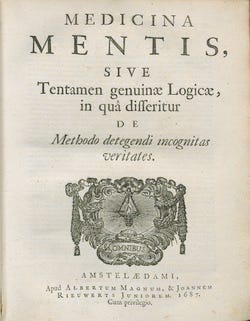
If we follow Stephanie Buchenau’s exposition (and we will) it was Francis Bacon’s program for invention as a logical expansion of pure rhetoric into pure invention – a look at how the mind interacted with the world and symbolic structures to outline new modes of engaging with reality. In taking up Bacon’s approach, Wolff started by following Leibnitz’s ideas about how “characteristic” signs and symbols were the simplest, most primitive way to elaborate the workings of the mind. For that – at least until 1720 when some of Leibnitz’s work on characteristics was published– Wolff had only a few hints. But fortunately (I feel a minor digression coming on) he had Tschirnhaus’ robust revision of Leibnitz’s basic methods Medicina mentis sive artis inveniendi preacepta generalia, presumably in the 1695 version because the earlier version had been attacked by Thomasius for being skeptical about free-floating demonic effluvia and being “Spinozist.” Which leads one to wonder:
a) Is there anyone that Thomasius did not attack for being skeptical about free-floating demonic effluvia?
b) Is there anyone (other than Spinoza) who was not attacked for being Spinozist?
c) Actually, Tschirnhaus had a novel defense against being attacked for being a Spinozist:
1) He had actually had some talks with Spinoza and had the letters to prove it
2) The printers had repeatedly messed up his carefully de-Spinozized terms because they were so used to putting in the Spinozian terms
Meanwhile, Stephanie Buchenau says that Tschirnhaus says (in more or less Spinozian terms) that the norm of sacred reason is inherent in the human mind so you don’t need specially coded Leibnitzian “characters” to figure things out. Which is a good thing since Leibnitz didn’t get very far in his invention of characters that would allow mental invention to occur. Good thing God thought of that first and not Leibnitz, I guess.
Well, Wolff must have said with a sigh of relief, what next?
Next, in fact, Wolff has to flee from Halle and Prussia under pain of death for being a little too fond of Confucius among other things offensive to the Piestist and the King of Prussia. More on that particularly early Enlightenment moment in the next post.
Sources:
MOGENS LÆRKE
“A Circle Without a Circle: Ehrenfried Walther von Tschirnhaus’s Natural Scientific Method” Journal of Modern Philosophy, 2026
Richard S. Westfall, Never at Rest, Cambridge U, 1980
IMMANUEL KANT Critique of the power of judgment edited by PAUL GUYER University of Pennsylvania translated by PAUL GUYER University of Pennsylvania ERIC MATTHEWS University of Aberdeen, Cambridge U, 2000
G. W. Leibniz and Samuel Clarke, Correspondence Edited, with Introduction, by Roger Ariew, Hackett Publishing Company, Inc. 2000
https://antigonejournal.com/2022/04/homer-iliad-scholia/
https://en.wikipedia.org/wiki/Philip_Melanchthon
https://en.wikipedia.org/wiki/Molinism
Juan Garcia’s article:
Anthony Grafton,
“PROLEGOMENA TO FRIEDRICH AUGUST WOLF”, J Warburg and Courtauld Institute, vol 44, 1981
Stefanie Buchenau. The Founding of Aesthetics in the German Enlightenment:The Art of Invention and the Invention of Art. Cambridge-New York: Cambridge University Press, 2013.
Mulsow, Martin, trans H. C. Erik Midelfort (!yes!) The Hidden Origins of the German Enlightenment, Cambridge U, 2023
Beyond Dordt and De Auxiliis The Dynamics of Protestant and Catholic Soteriology in the Sixteenth and Seventeenth Centuries Edited by Jordan J. Ballor, Matthew T. Gaetano, and David S. Sytsma, Brill, 2019
Clark, Christopher Iron Kingdom, Harvard U, 2006
And the post that came just before this one:

And topics:
Guide to Topics in Some Order

I was wondering how to set the background for what I thought I was trying to say about Schelling’s Ages of the World, a series of strange texts amounting to several different versions of thousands of pages of attempts to work out the stages of how the mind and the natural world emerged from a slew of ever-changing imaginary abyssal environments that he …