


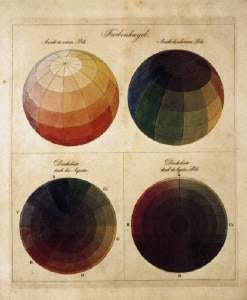
The Spheres there are by P. Otto Runge in 1809.
As Manfred Frank points out in lecture 10 of his Philosophical Foundations of Early German Romanticism, Schlegel is a little late in the constellation or trajectory of Jena (or early or Frühromantik) Romanticism. Novalis, for example, was active in Jena five years before Schlegel arrived. Novalis was a visionary poet of Night as a sublimely hallucinogenic realm of many-facetted hopes and fears, especially in his Hymns to the Night from the interior of which darkness we see the world sinking away at some distance into a forlorn grave alone, enshrouded in grey, distanced by memory, submerged in dew, dreams and ashes.
Meanwhile, much later ( from about 2015 to now) Philipp Weber, working with early Romanticism in terms of cosmos and subjectivity (see the article indicated in the sources section below), has suggested that the present world (such as seen from the point of view of Night in Novalis’ Hymns to the Night) in Schlegel’s philosophy around 1800 was unfinished. Schlegel thought this was consistent with the various cosmic antimonies that Kant had noted. Weber argues that early Romanticism has a reverse side, a very dark side, wherein the worldly human viewer is to consider themselves as actively making their way through a world that is still under construction and where there is no definite support for any unified and dreamy longing for the sublimely indeterminate because even the sublimely indeterminate is not really there at all. It is a vision. It is a memory. It is a grave.
But the grave isn’t really there. Even oblivion doesn’t quite happen. The pieces never all get joined up. The fragments are ever-shifting and Schlegel is happy with all that ironic Romantic Negativism. Note that this is very different from Nihilism, as Schlegel gladly ironically notes in opposition to the inventor of Nihilism, Jacobi. One Jacobian leap doesn’t take you out of fragments to a completed world, you are running toward that leap, but you never get there. And keep in mind that Historicism in its attempt to guarantee a lost completeness for the sake of Modernism, triggers Nihilism when that Historicist completeness does not arrive as expected or even at all. Yes, Romantic Negativity is a very different kind of negativity.
And so, in his final, supremely unsuccessful lecture in Jena on March 24th 1801 as Novalis lay dying, Schlegel asked, “Why doesn’t the play (spiel, game) of Nature end immediately, so that absolutely nothing exists?” Well, that’s quite a gambit. Some kind of unnatural repetition forces incompleteness. Or, to exist is to exist as fragmentary. Nothing hangs between the pieces. In the interstices we glimpse the immense darkness around us. Here, even the bold Weber must flee to a footnote on the logic of Brigitte Falkenburg’s exegesis of Kant’s cosmology: “The Completion of the concept of the understanding of Nature to the cosmological concept of the world is illegitimate…”
With an illegitimate universe at hand, one might (in skipping over Žižek as one always has to at this point in discussing early Romanticism) jump to St. Augustine and the early Kant and continuous creation or follow Schlegel into new territory and take the universe as a nascent reality on its own – something “completely different” (as Weber boldly says), a place of the permanently potential transgression of any boundaries at all – pantheism with a vengeance – the dark and mysterious source of the “incursion of the other” in Romantic art.
I suppose we more or less have zoomed into mysticism, a hazard that Schlegel notes according to Manfred Frank in a fragment that reads “mysticism is the most somber and most solid of all furies.”
I haven’t checked that translation but let us suppose by “fury” that Schlegel means, in the Latin-derived term, the form that the Erinyes take when they pursue vengeance on Earth and not in the Heavens or in the Underworlds. Maybe we can leave it all there for now at the release of ancient and absolute vengeful darkness into the Romantic world. Any singular Erinys is dark and ancient enough, being attested in Linear B from the tablets at Knossos on Crete in the forms 𐀁𐀪𐀝, e-ri-nu and 𐀁𐀪𐀝𐀸, e-ri-nu-we
Here I sign off in the somber shadows of the Furies’ wings and take refuge in my sources
Oh, and at one point, Novalis (note 743), suggests that the colors of different celestial objects, aethers and firmaments are derived each one from their own particular “Night”.
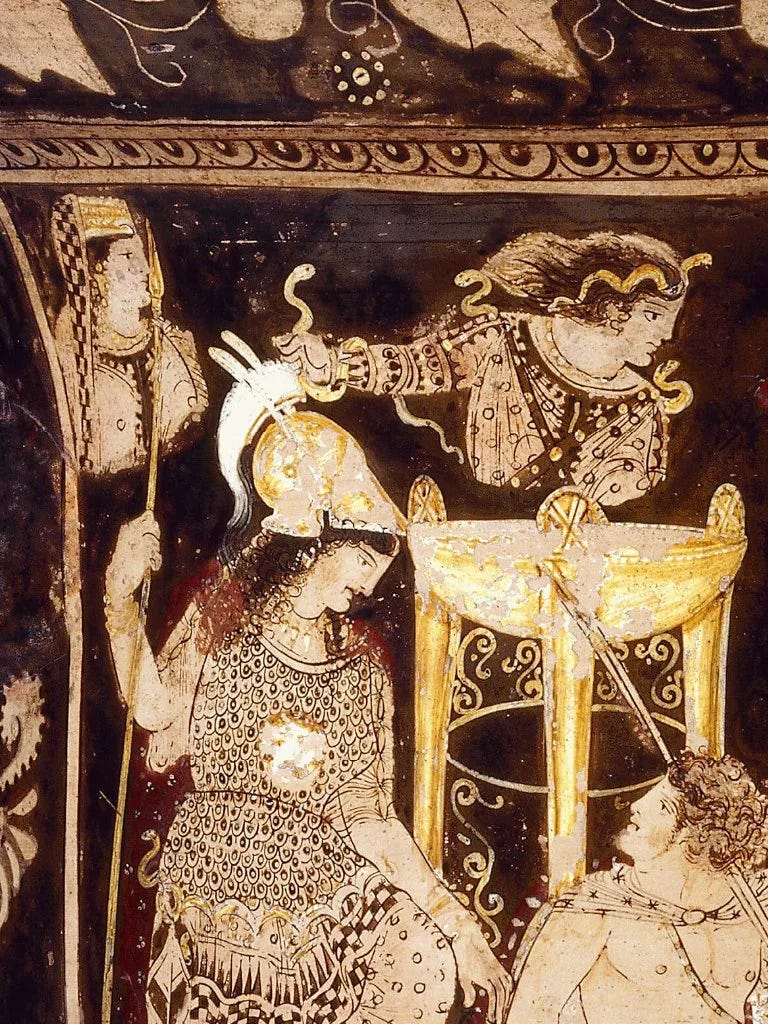
Some furies.
Sources:
Wood, David W. ed and trans, Novalis Notes for a Romantic Encyclopedia
Millan-Zaibert, Elizabeth, Friedrich Schlegel and the Emergence of Romantic Philosophy
Ameriks, Karl ed, The Cambridge Companion to German Idealism
Millan-Zaibert, Elizabeth, trans., Manfred Frank, The Philosophical Foundations of Early German Romanticism
Philipp Weber’s Article on Romantic Acosmism in THE GERMANIC REVIEW: LITERATURE, CULTURE, THEORY 2021, VOL. 96, NO. 1, 23–40 https://doi.org/10.1080/00168890.2020.1862035
https://www.tandfonline.com/doi/full/10.1080/00168890.2020.1862035
Wikipedia on the Furies:
https://en.wikipedia.org/wiki/Erinyes
Novalis:
https://en.wikipedia.org/wiki/Novalis
F. Schlegel: